Marina Aquarium Thermometer Review: 5 Best Picks Compared (2026)
Marina aquarium thermometer review covering five popular models. Compare floating, standing, LCD and suction-cup designs to find the right reef tank thermometer
 By Emily Parker
Updated November 24, 2026
 By Emily Parker
Updated November 2026
A reliable marina aquarium thermometer review starts with one question: which temperature gauge will keep your reef or saltwater tank within the narrow band your livestock needs? Reef corals, fish and invertebrates generally do best somewhere around 76 to 80°F, and a swing of even two or three degrees over a day can stress sensitive animals. This guide compares five Marina-branded and similar aquarium thermometers on readability, mounting style, display type, suitability for saltwater and overall fit for different tank setups. Our criteria were specifications, brand reputation and common owner feedback patterns. We did not test these units ourselves.
Our top picks at a glance
- 1TOP CHOICEBest overallMarina Deluxe Floating Thermometer with Suction CupView on Amazon
- 2
 TOP CHOICEBest for planted and display tanksPenn-Plax Therma-Temp Floating Aquarium ThermometerView on Amazon
- 3
 TOP CHOICEBest for sump and cabinet viewingMarina Large Standing ThermometerView on Amazon
- 4
 Best for quick digital readingsAQUANEAT Aquarium Thermometer, Fish Tank Thermometer, Digital TemperatView on Amazon
- 5
 Best budget pickMarina Plastic Thermometer with Suction CupView on Amazon
Our Top Picks
| Product | Best for | Key feature |
|---|---|---|
| Marina Deluxe Floating Thermometer with Suction Cup | Most reef and fish tanks | Floats or mounts on the glass with a suction cup |
| Penn-Plax Therma-Temp Floating Aquarium Thermometer | Planted and display tanks | Easy-to-read dial with removable mount, rated for saltwater |
| Marina Large Standing Thermometer | Sumps, cabinets and dim spaces | Dual Fahrenheit and Celsius scales on a large face |
| AQUANEAT Aquarium Thermometer | Quick digital readings | Large LCD display |
| Marina Plastic Thermometer with Suction Cup | Budget setups and spares | Simple plastic body with suction mount |
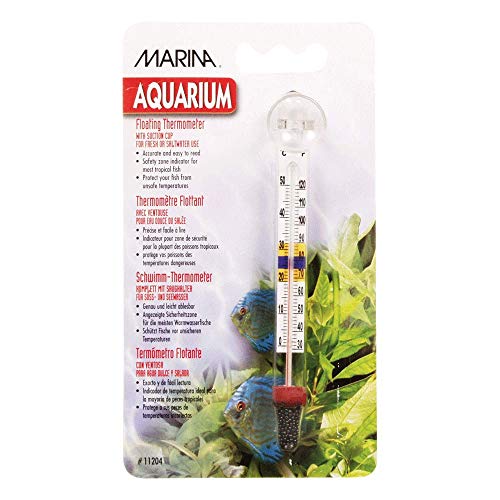
Marina Deluxe Floating Thermometer with Suction Cup
Marina Deluxe Floating Thermometer with Suction Cup
Best for: Most reef and fish tanks that need a dependable, all-around analog gauge.
This is a good starting point for hobbyists who want a traditional thermometer that works whether it floats freely or sits on the glass. It suits most freshwater and marine tanks of moderate size, especially if you prefer to check temperature at a glance without a battery.
Key specs:
- Analog glass-style gauge read by eye
- Suction cup mount for attaching to the tank wall
- Floating design for free placement
Pros:
- No batteries required
- Flexible mounting options
- Familiar analog reading style
Cons:
- Small scale can be harder to read from across the room
- Suction cups can loosen over time, especially with salt creep
Bottom line: A solid default choice for owners who want a simple, low-maintenance gauge for a typical reef or fish tank.
View on AmazonPenn-Plax Therma-Temp Floating Aquarium Thermometer
Penn-Plax Therma-Temp Floating Aquarium Thermometer – Multicolor, 4.25 In | Easy to Read – Temperature Gauge with Optional Suction Cup & Removable Mount – Safe for Freshwater & Saltwater Tanks
Best for: Planted and display tanks where a clean, easy-to-read dial matters.
Hobbyists with aquascaped or display tanks often want a thermometer that looks tidy and can be placed discreetly. The removable mount and optional suction cup make it adaptable to different glass and sump layouts.
Key specs:
- Approximately 4.25-inch body
- Multicolor dial for quick reading
- Removable mount with optional suction cup
- Listed as safe for freshwater and saltwater tanks
Pros:
- Clear dial that is easy to read
- Flexible placement (floating or mounted)
- Compact enough for smaller tanks
Cons:
- Analog accuracy can drift if not calibrated against a second reference
- Mount may need reseating after water changes
Bottom line: Best for owners who want a neat, discreet gauge in a display or planted setup and are comfortable verifying it occasionally.
View on AmazonMarina Large Standing Thermometer
Marina Large Standing Thermometer | Provides Temperature in Fahrenheit and Celsius
Best for: Sumps, cabinets and dimly lit spaces where the reading needs to be seen from a distance.
Standing thermometers work well when the tank is not easy to see into, such as a sump or equipment bay. The large face and dual scales help when multiple people check the tank.
Key specs:
- Large standing face
- Fahrenheit and Celsius scales
Pros:
- Easy to read at a distance
- Dual temperature scales
- Can be placed in sumps and cabinets
Cons:
- Takes up more physical space than floating models
- Less practical for small nano tanks
Bottom line: A strong pick for sump-based reef systems or any setup where the tank is partly hidden.
View on AmazonAQUANEAT Aquarium Thermometer, Fish Tank Thermometer, Digital Temperature Test, with Large LCD Display
AQUANEAT Aquarium Thermometer, Fish Tank Thermometer, Digital Temperature Test, with Large LCD Display (1 Pack)
Best for: Owners who want fast digital readouts and a larger number they can check without leaning in.
Digital probes appeal to reefers who prefer numeric readings over analog needles. A large LCD makes it easier to spot small changes, especially when temperatures are being adjusted during heater tuning.
Key specs:
- Large LCD display
- Single-pack listing
- Digital temperature readout
Pros:
- Easy-to-read digital numbers
- Useful during heater adjustments
- Compact probe format
Cons:
- Depends on batteries or a power source for display
- Probe placement needs care to avoid heater or pump hot spots
Bottom line: A good fit for owners who prefer digital readouts and are comfortable managing battery replacement.
View on AmazonMarina Plastic Thermometer with Suction Cup
Marina Plastic Thermometer with Suction Cup
Best for: Budget setups, spares for multiple tanks or a simple backup gauge.
Not every tank needs a premium gauge. A plastic suction-cup thermometer works well as a secondary check or for a smaller freshwater system where precision demands are modest.
Key specs:
- Plastic body
- Suction cup mount
Pros:
- Simple and inexpensive to keep as a spare
- Easy to mount on the glass
- No batteries required
Cons:
- Plastic faces can scratch or fog over time
- Suction cups can lose grip in saltwater
Bottom line: A reasonable budget or backup choice, best paired with a second reference reading.
View on AmazonBuying Guide
Display type: analog, digital or both
Analog gauges are simple and battery-free, while digital probes give a numeric readout that is easier to interpret at small increments. Many reefers keep one of each as a cross-check.
Good picks for this: AQUANEAT Aquarium Thermometer, Marina Deluxe Floating Thermometer with Suction Cup
Mounting style
Floating, suction-cup and standing designs each suit different tank layouts. Floating models work in open tanks, suction cups suit glass walls, and standing models fit sumps and cabinets.
Good picks for this: Marina Large Standing Thermometer, Penn-Plax Therma-Temp Floating Aquarium Thermometer
Saltwater compatibility
Check that the thermometer is listed for saltwater use. Salt creep can degrade suction cups and cloud plastic faces over time, so inspect the unit regularly.
Good picks for this: Penn-Plax Therma-Temp Floating Aquarium Thermometer, Marina Deluxe Floating Thermometer with Suction Cup
Readability
Look for a clear scale with fine markings, ideally in 1-degree increments. Large faces or displays help when reading from across the room.
Good picks for this: Marina Large Standing Thermometer, AQUANEAT Aquarium Thermometer
Accuracy and calibration
No thermometer is perfectly accurate out of the box. Compare readings against a second, trusted thermometer and note any consistent offset. Digital and analog models both drift over time.
Good picks for this: Penn-Plax Therma-Temp Floating Aquarium Thermometer, AQUANEAT Aquarium Thermometer
Durability and care
Rinse thermometers with fresh water after cleaning, avoid abrasive pads on the glass and replace suction cups that no longer hold. Plastic bodies are less durable than glass-style units.
Good picks for this: Marina Deluxe Floating Thermometer with Suction Cup, Marina Plastic Thermometer with Suction Cup
Power source
Analog models need no power. Digital probes need batteries or a power source, so factor replacement into your maintenance routine.
Good picks for this: AQUANEAT Aquarium Thermometer, Marina Large Standing Thermometer
FAQ
Is a marina aquarium thermometer accurate enough for reef tanks?
Most reefers use these gauges as a monitoring tool rather than a precision instrument. Check the reading against a second thermometer, and aim for a stable temperature rather than an exact number.
Where should I place a floating thermometer?
Position it away from heaters, return outlets and direct lighting, in an area that reflects the tank’s average temperature. Mid-depth on the opposite side from the heater works well.
Can I use a freshwater thermometer in saltwater?
Many thermometers are sold for both, but confirm the listing states saltwater compatibility. Salt residue can damage some suction cups and finishes.
How often should I replace a digital aquarium thermometer battery?
Battery life varies by model and display type. Replace batteries when readings become faint or erratic, and keep a spare on hand.
Why does my thermometer read differently from my heater?
Heaters often have their own built-in sensors that may read slightly differently. Compare both against a reference thermometer to find the actual tank temperature.
Should I use more than one thermometer?
Yes, many reefers use two. Running an analog and a digital unit side by side makes drift easy to spot.
Conclusion
For most reef and fish tanks, the Marina Deluxe Floating Thermometer with Suction Cup is a straightforward all-around choice. Owners of display or planted tanks may prefer the Penn-Plax Therma-Temp for its tidy dial, while sump-based systems suit the Marina Large Standing Thermometer. If you want digital readouts, the AQUANEAT model is worth a look, and the Marina Plastic Thermometer works as a budget or backup gauge. Whichever you choose, verify it against a second reference reading.
Sources
- Background on water temperature and its effects on marine environments (noaa.gov)
- Water temperature measurement principles and calibration basics (usgs.gov)
- Guidance on accurate water temperature monitoring (epa.gov)
Before you buy: helpful guides
- How to Read Marina Aquarium Thermometer: A Step-by-Step Guide for Reefers
- Floating Thermometer for Aquarium: Which Type Reads Accurately?
- Floating Glass Aquarium Thermometer: Why Readings Drift and How to Fix It
- Zoo Med Digital Aquarium Thermometer: Setup, Accuracy and Tips (2026)
- Glass Thermometer for Aquarium: How to Choose and Read One (Step-by-Step)
About Emily Parker
Emily Parker is part of our editorial team and reviews and edits our reef & saltwater aquariums guides, checking product details against manufacturer specifications and owner feedback.
About the author
Emily Parker writes reviews and buying guides for My Reef Aquarium.