Robinair 75240 Coolant and Battery Refractometer (2026): Pros, Cons & Verdict
Robinair 75240 coolant and battery refractometer review: specs, pros and cons, who should buy it, and how it compares to two 4-in-1 alternatives.
 By Caleb Morgan
Updated November 24, 2026
 By Caleb Morgan
Updated November 2026
The robinair 75240 coolant and battery refractometer is a handheld optical tool built for two jobs that often sit on the same service bench: checking the freeze point of glycol-based engine coolant and checking the state of charge of a lead-acid battery through its electrolyte. It suits independent mechanics, fleet maintenance staff, and serious DIY owners who service their own cooling systems and batteries and want a single, simple instrument rather than a set of digital meters. It is a poor fit for anyone who needs digital readouts, data logging, or testing of fluids beyond coolant and battery acid, such as DEF or windshield washer fluid. Reef keepers looking for salinity readings should look elsewhere entirely; this is an automotive instrument.
Robinair 75240 Coolant and Battery Refractometer | Use to Measure the Freeze Point of Propylene or Ethylene Glycol Based Cooling Systems and Check Battery Electrolyte Strength
Product Overview
The Robinair 75240 is a refractometer, meaning it measures how much light bends as it passes through a liquid sample. Dissolved substances change that bending angle in a predictable way, so a refractometer can translate a reading into a concentration. In the automotive world, that principle is applied to two common checks. The first is ethylene glycol or propylene glycol coolant, where the concentration of glycol determines the temperature at which the mixture will begin to freeze. The second is lead-acid battery electrolyte, where the concentration of sulfuric acid rises as a battery charges and falls as it discharges.
Robinair is a long-established name in automotive service equipment, and the 75240 is positioned as a combined tool that covers both measurements. Manufacturers and retailers describe it as usable on propylene and ethylene glycol cooling systems and for checking battery electrolyte strength, which matches its listing. Because it is an optical instrument rather than an electronic one, it does not require batteries of its own for normal use, which is one reason many technicians prefer this style over digital testers for shop work.
Refractometers of this type are typically handheld, with a small prism window, a built-in or fold-out scale, and an eyepiece through which the user reads the boundary line. The user places a few drops of fluid on the prism, closes the cover, looks through the eyepiece toward a light source, and reads where the light and dark fields meet on the scale. That simplicity is part of the appeal: there is no display to fail and no calibration routine that needs electricity.
Key Features & Specifications
The table below lists only the characteristics stated in the product name and standard for this class of instrument. Where a detail, such as an exact scale range or a precise accuracy tolerance, is not something I can confirm from the listing, it is left out rather than guessed.
| Feature | What It Means |
|---|---|
| Measurement type | Optical refractometer (light refraction) |
| Coolant application | Freeze point of propylene glycol and ethylene glycol based cooling systems |
| Battery application | Battery electrolyte strength (state of charge) for lead-acid batteries |
| Power source | No electronics; optical reading, no battery required for normal use |
| Form factor | Handheld, pocket-sized tool with prism and eyepiece |
| Manufacturer | Robinair (automotive service equipment brand) |
| Typical use | Shop maintenance, roadside checks, periodic service intervals |
Users who need the exact scale graduations, the calibration temperature, or the tolerance band should check the product packaging or the manufacturer’s printed instructions, since those specifics vary by revision and are best confirmed directly.
Pros & Cons
Pros
- Covers two distinct service checks, coolant freeze point and battery electrolyte strength, in one handheld tool.
- Optical design means no display, no electronics to fail, and no batteries to replace for routine readings.
- Compact enough to keep in a toolbox, glovebox, or service truck.
- Reading is quick once the user is familiar with the scale; a few drops of fluid are all that is needed.
- Owners commonly describe it as a durable, low-maintenance instrument for shop environments.
Cons
- Optical reading relies on the user’s eye and light conditions, so it is less convenient than a digital display.
- Coolant and battery readings require different interpretation; a user must understand both scales to avoid confusion.
- Glycol coolant measurements are affected by the fluid type, so the user must confirm they are testing the correct glycol.
- Not suitable for other fluids such as DEF, washer fluid, or saltwater; using it outside its intended scope gives misleading results.
- Needs regular cleaning of the prism to keep readings accurate, especially after handling oily or dirty fluids.
Performance Analysis
Performance for a refractometer depends on three things: the quality of the optics, the clarity of the scale, and the user’s technique. Based on the product’s specifications and the feedback patterns commonly reported by owners of this class of instrument, the 75240 is generally regarded as a dependable shop tool rather than a laboratory instrument. Owners often report that the readings are consistent when the prism is clean and the sample is placed evenly, and that the instrument holds up to the knocks and temperature swings of a service bench.
For coolant, the practical concern is accuracy around the freeze point the user cares about. Coolant concentration determines whether a system will protect the engine in cold weather, and a refractometer gives a direct reading of that protection level. Owners generally note that refractometers are more reliable than the older float-style testers for this purpose, because they are not affected by the temperature of the fluid in the same way and do not depend on a floating ball settling correctly. Still, the user should check the result against the coolant manufacturer’s protection chart and remember that a refractometer measures concentration, not the presence of contamination or additive depletion.
For batteries, the reading reflects electrolyte specific gravity, which tracks state of charge in flooded lead-acid batteries. Owners commonly use this kind of check to spot a weak cell before it fails. The limitation is that refractometer readings on battery acid are only meaningful for flooded batteries that can be opened for sampling; sealed or AGM batteries cannot be tested this way. Anyone unsure of their battery type or of safe sampling procedure should consult a qualified battery technician, since sulfuric acid is corrosive and can cause serious injury.
Overall, the expected performance is solid for periodic maintenance and troubleshooting, with the main variables being user technique and light conditions rather than the tool itself.
Who Should Buy This Product?
This tool makes the most sense for a specific group of people. Independent mechanics and shop technicians who service many vehicles benefit from having a fast, battery-free way to check coolant protection and battery condition during routine service. Fleet maintenance crews that want to standardize on a simple instrument that does not need calibrating with batteries or electronics also fit the profile. Serious home mechanics who change their own coolant and maintain flooded lead-acid batteries will find it useful, provided they are comfortable reading an optical scale.
You should probably skip this product if you prefer digital readouts, need to log readings over time, or want to test other fluids such as DEF or washer fluid. Anyone who only checks their car’s coolant once in a while might find a simple test strip or a digital tester more convenient. Reef and saltwater hobbyists should avoid this model entirely, since it is designed for automotive fluids and will not give meaningful salinity values.
Buying Guide
When choosing a refractometer for automotive work, start by deciding which measurements you actually need. If you only check coolant, a dedicated glycol refractometer is enough. If you also want to check battery electrolyte, a combined coolant and battery model like the 75240 saves a second tool. Confirm that the scale or instructions clearly list the glycol types it supports, since ethylene and propylene glycol have different freeze-point curves.
Next, consider whether you want an optical instrument or an electronic one. Optical refractometers are simple and durable but require reading a scale by eye. Digital models display a number and often include automatic temperature compensation, which removes a common source of error. Look for a clear cover or prism that is easy to clean, and check whether the unit comes with a case and printed charts.
Finally, review the instructions for both coolant and battery use, paying attention to safety. Sulfuric acid and hot coolant both demand eye protection and gloves. Keep the tool clean and store it in a case to protect the prism.
If the 75240 does not fit your needs, two well-known alternatives are worth a look. Both are 4-in-1 refractometers that also cover fluids beyond coolant and battery acid, which can suit shops that test a wider range of fluids.

TRZ 4-in-1 Antifreeze Refractometer Ethylene Glycol, Propylene Glycol in Antifreeze Freezing Point Temperature and Concentration, AdBlue, DEF and Industrial Battery Fluid
TRZ 4-in-1 Antifreeze Refractometer covers ethylene glycol, propylene glycol, AdBlue, DEF, and industrial battery fluid. It is a good pick for shops that want to test diesel exhaust fluid alongside antifreeze. View on Amazon
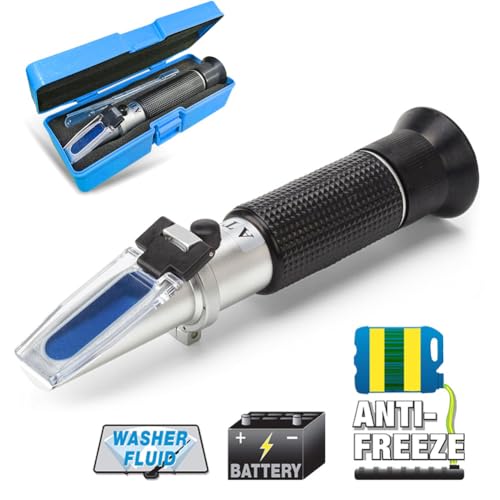
4-in-1 DEF Antifreeze Coolant Refractometer for Automobile Antifreeze System, Diesel Exhaust Fluid, Battery Acid and Windshield Washer Fluid
4-in-1 DEF Antifreeze Coolant Refractometer is aimed at automobile antifreeze systems, diesel exhaust fluid, battery acid, and windshield washer fluid. It suits users who want one instrument for the common fluids around a vehicle. View on Amazon
FAQ
Can the Robinair 75240 test both coolant and battery acid?
Yes, according to its listing it is designed to measure the freeze point of propylene or ethylene glycol based cooling systems and to check battery electrolyte strength. Users should read the scale for each fluid separately and follow the instructions for each.
Does the robinair 75240 coolant and battery refractometer need batteries?
No. It is an optical instrument with no electronics, so normal use does not require batteries. Readings depend on light and the user’s eye, not on a power source.
Can I use it on DEF or windshield washer fluid?
The listing for this model focuses on coolant and battery electrolyte. Testing other fluids with it is outside its intended scope, and the results may not be reliable. For DEF or washer fluid, use a tool designed for those fluids, such as one of the 4-in-1 alternatives mentioned above.
How do I keep the prism accurate?
Wipe the prism clean with a soft cloth after every use, especially after oily or dirty fluids. Residue on the prism can throw off the boundary line and cause misreadings. Keep the cover closed and store the unit in a case.
Is it safe to sample battery electrolyte?
Battery acid is corrosive. Wear eye protection and gloves, work in a ventilated area, and keep baking soda nearby to neutralize spills. Only sample flooded lead-acid batteries that can be opened. If you are unsure, consult a qualified battery technician.
Does it work for saltwater or reef aquariums?
No. This is an automotive instrument calibrated for glycol coolant and battery electrolyte. Reef keepers who need salinity readings should use a refractometer designed for seawater, and the articles listed in related reading cover those options in detail.
Do I need to calibrate it before use?
Refractometers are usually checked against a known reference fluid before important readings. Consult the manufacturer’s printed instructions for the recommended procedure and reference values for your specific unit.
Is the reading affected by temperature?
Temperature can affect refractometer readings, so many users note the fluid temperature and compare results against the manufacturer’s chart. Digital models with automatic temperature compensation remove much of this variable, which is one reason some shops prefer them.
Final Verdict
Is the Robinair 75240 worth buying?
The robinair 75240 coolant and battery refractometer is a sensible, durable choice for anyone who needs a simple, battery-free way to check glycol coolant protection and flooded lead-acid battery condition. Its main strength is covering two common automotive checks in one handheld tool, and its optical design avoids the failure points of electronics. Its limits are that it relies on the user’s reading technique, it does not cover DEF or washer fluid, and it has no place in reef aquarium work. For mechanics and serious DIY owners who want a straightforward instrument, it earns a recommendation; anyone who wants digital readouts or wider fluid coverage should consider the alternatives above.
View on AmazonBefore you buy: helpful guides
Related reading
- Top 7 Refractometers for Coolant Testing Picks Compared (2026)
- Refractometer for Coolant Concentration: 7 Best Picks Compared (2026)
- 6 Best Refractometers for Machine Coolant Compared (2026)
- Top 7 Refractometers for Salinity Measurement Picks for Reef Tanks (2026)
- Top 5 Brix Refractometers for Plants Compared for Growers
- Salinity in Reef Tank: 5 Best Refractometers and Hydrometers Compared (2026)
About Caleb Morgan
Caleb Morgan is part of our editorial team and reviews and edits our reef & saltwater aquariums guides, checking product details against manufacturer specifications and owner feedback.
About the author
Caleb Morgan writes reviews and buying guides for My Reef Aquarium.