5 Best Marina Aquarium Floating Thermometer Picks Compared (2026)
Comparing five marina aquarium floating thermometer options by accuracy, glass build, display type and placement fit, so you can pick the right one for your tan
 By Emily Parker
Updated November 10, 2026
 By Emily Parker
Updated November 2026
Choosing a marina aquarium floating thermometer sounds simple, but the differences between floating glass models, digital stick-ons and standing thermometers matter when you are trying to keep a reef or freshwater tank within a narrow temperature band. This list compares five options against four criteria: how the device is built and whether it floats or stands, how easy it is to read from across the room, how it attaches or stays in position, and how well the design suits saltwater and freshwater setups. The picks below are based on manufacturer specifications, brand reputation and common owner feedback patterns. We have not tested these products ourselves.
Our top picks at a glance
- 1TOP CHOICEBest overallMarina Deluxe Floating Thermometer with Suction CupView on Amazon
- 2
 TOP CHOICEBest for digital readoutsPAIZOO Aquarium Thermometer Digital, Highly Accurate Fish Tank ThermometerView on Amazon
- 3
 TOP CHOICEBest for mercury-free glassLABO Floating Aquarium Thermometer – Glass, Mercury-FreeView on Amazon
- 4
 Best for easy reading from a distanceMarina Large Standing ThermometerView on Amazon
- 5
 Best budget pickDreyoo 4 Pack Floating Aquarium ThermometersView on Amazon
Our Top Picks
Quick Comparison
| Product | Best for | Key feature |
|---|---|---|
| Marina Deluxe Floating Thermometer with Suction Cup | General freshwater and saltwater tanks | Floating glass body with suction cup mount |
| PAIZOO Aquarium Thermometer Digital | Owners who want a backlit digital reading | LED display with stick-on sensor |
| LABO Floating Aquarium Thermometer | Mercury-free glass with a floating design | Glass body without mercury |
| Marina Large Standing Thermometer | Viewing temperature across the room | Dual Fahrenheit and Celsius scales |
| Dreyoo 4 Pack Floating Aquarium Thermometers | Multi-tank owners and budget buyers | Four units in one pack with suction cups |
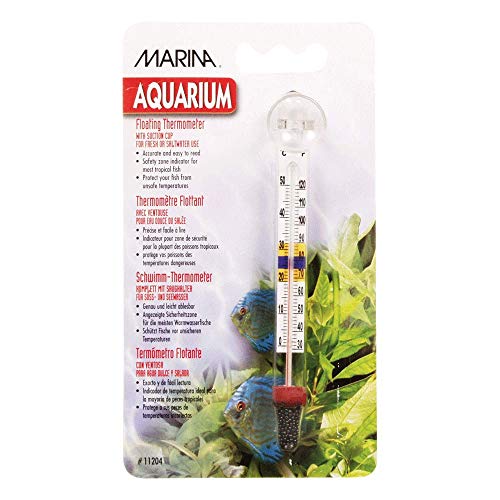
Marina Deluxe Floating Thermometer with Suction Cup
Marina Deluxe Floating Thermometer with Suction Cup
Best for: General freshwater and saltwater tanks where a simple, dependable glass thermometer is the goal.
This is a classic floating glass thermometer aimed at hobbyists who want a familiar, low-maintenance tool. It fits well in tanks where you can reach the glass to attach it and read it at a glance.
Key specs:
- Floating glass tube design
- Suction cup mount for placement on the glass
Pros:
- Simple design with no batteries or electronics to fail
- Suction cup keeps it in a chosen spot
- Familiar format that many owners already trust
Cons:
- Reading requires getting close enough to see the scale
- Glass units can drift if the suction cup loosens over time
Bottom line: A solid, no-nonsense choice for owners who want a traditional glass thermometer that works with almost any tank setup.
View on AmazonPAIZOO Aquarium Thermometer Digital, Highly Accurate Fish Tank Thermometer
PAIZOO Aquarium Thermometer Digital, Highly Accurate Fish Tank Thermometer | LED Display, 8000h Battery Life, Precise Temp Gauge, Range 0-140℉, Stick-on Fish Tank Thermometer for Betta, Axolotl & Turt
Best for: Owners who want an easy-to-read digital display instead of a glass scale.
This stick-on digital unit suits keepers who check temperature often and prefer a numeric LED readout. It is designed to stay attached to the outside of the glass rather than floating in the water.
Key specs:
- LED digital display
- Stick-on mounting to the exterior glass
- Listed temperature range of 0 to 140°F
Pros:
- Numeric display is quick to read
- No mercury or glass tube to break
- Works on the outside of the tank, so nothing sits inside the water
Cons:
- Relies on a battery, so it needs periodic replacement
- Exterior sensors read the glass surface temperature, which can lag the water slightly
Bottom line: A good fit for owners who want a clear digital number and are comfortable with a battery-powered sensor.
View on AmazonLABO Floating Aquarium Thermometer – Glass, Mercury-Free
LABO Floating Aquarium Thermometer – Glass, Mercury-Free Fish Tank Thermometer, Safe Thermometer for Fish Tank, Ideal for Freshwater and Saltwater Aquariums
Best for: Keepers who want a floating glass thermometer without mercury, for freshwater or saltwater.
This model combines the floating glass format with a mercury-free build, which many owners prefer for peace of mind around fish and invertebrates.
Key specs:
- Glass body
- Mercury-free construction
- Floating design for use in freshwater and saltwater
Pros:
- Mercury-free glass build
- Floats freely, so it can be moved between spots
- Suitable for both freshwater and saltwater
Cons:
- Glass is fragile and can break if dropped during cleaning
- Small scale can be harder to read without close inspection
Bottom line: A sensible choice for owners who want a floating glass unit without mercury and plan to handle it carefully.
View on AmazonMarina Large Standing Thermometer
Marina Large Standing Thermometer | Provides Temperature in Fahrenheit and Celsius
Best for: Reading temperature quickly from across the room.
This larger-format thermometer is built for visibility. It suits tanks in a living room or office where you want to glance at the water without leaning in.
Key specs:
- Large standing format
- Dual Fahrenheit and Celsius scales
Pros:
- Large scale is easy to read from a distance
- Shows both Fahrenheit and Celsius
- Simple to use with no electronics
Cons:
- Bulkier than floating or stick-on models, which can be a problem in small tanks
- Placement needs enough room in the tank to stand upright
Bottom line: Best for larger tanks and owners who value readability over a compact footprint.
View on AmazonDreyoo 4 Pack Floating Aquarium Thermometers
Dreyoo 4 Pack Floating Aquarium Thermometers, 0-43°C/32-110°F | with Suction Cup, Glass Material, Mercury Free Large Standing Thermometer for Freshwater and Saltwater Fish
Best for: Multi-tank owners and buyers who want spares or a budget-friendly set.
This pack gives you four floating glass units with suction cups, which is useful if you run several tanks, a quarantine tank and a sump, or simply want backups.
Key specs:
- Pack of four units
- Listed range of 0 to 43°C / 32 to 110°F
- Glass body, mercury-free, with suction cup
Pros:
- Four units cover multiple tanks or spares
- Mercury-free glass construction
- Suction cups help hold placement
Cons:
- Glass units are fragile and wear out with handling
- Accuracy varies between floating thermometers, so compare readings against a second device
Bottom line: A practical set for owners running more than one tank or who want to keep spares on hand.
View on AmazonBuying Guide
Floating, standing, or stick-on design
Floating thermometers sit in the water column and can move around, which makes them easy to relocate but sometimes unstable. Standing models need enough internal space to stay upright. Stick-on digital sensors stay on the outside of the glass and avoid anything inside the tank, but they read glass temperature, which can lag the water slightly.
Good picks for this: Marina Deluxe Floating Thermometer with Suction Cup, Marina Large Standing Thermometer
Mercury-free construction
Many older glass thermometers used mercury. Mercury-free glass units avoid that concern entirely, which matters if a unit breaks during a water change. Check the listing or packaging for a mercury-free statement before buying.
Good picks for this: LABO Floating Aquarium Thermometer, Dreyoo 4 Pack Floating Aquarium Thermometers
Display and readability
If you check temperature from across the room, look for a large scale or an LED display. Dual Fahrenheit and Celsius scales help if you follow protocols written in either unit. Small floating scales can be hard to read in dim lighting.
Good picks for this: PAIZOO Aquarium Thermometer Digital, Marina Large Standing Thermometer
Tank size and placement
Nano tanks have little room, so a bulky standing unit may not fit. Larger tanks can accommodate standing models. Placement should be away from heaters, filter outlets and direct light, because those can create readings that do not reflect the main water body.
Good picks for this: Marina Deluxe Floating Thermometer with Suction Cup, PAIZOO Aquarium Thermometer Digital
Accuracy and cross-checking
No consumer thermometer is a calibrated laboratory instrument. Many reefers compare a new unit against a second thermometer for a few days. If two devices differ by more than a degree or so, note the offset and track changes rather than the absolute number. Manufacturers typically do not publish calibration certificates for these models.
Good picks for this: Dreyoo 4 Pack Floating Aquarium Thermometers, LABO Floating Aquarium Thermometer
Durability and care
Glass units can crack if handled roughly during cleaning, and suction cups can lose grip over time. Digital units depend on battery life. Inspect your thermometer monthly, replace batteries on schedule, and keep spare units if you run multiple systems.
Good picks for this: Dreyoo 4 Pack Floating Aquarium Thermometers, PAIZOO Aquarium Thermometer Digital
Use case: freshwater, saltwater, or both
Most floating and stick-on thermometers work in both freshwater and saltwater, but saltwater reefers often prefer a unit with a clear, stable reading in a higher-density environment. Confirm the listing says it is suitable for your tank type.
Good picks for this: LABO Floating Aquarium Thermometer, Marina Large Standing Thermometer
FAQ
Is a marina aquarium floating thermometer accurate enough for reef tanks?
It is accurate enough for routine monitoring, which is what most reef keepers need. For critical work, compare it against a second thermometer and track the offset. Consult a professional aquarist if you are dealing with livestock health concerns tied to temperature.
Where should I place a floating thermometer?
Place it in an open area of the main display, away from heaters, return outlets and direct light. Avoid corners where water is still, and avoid spots where the heater can warm the sensor directly.
Are mercury-free thermometers better?
Mercury-free models avoid the risk of mercury exposure if a glass unit breaks. Check the packaging or listing to confirm the construction before buying.
How often should I replace a floating glass thermometer?
There is no universal schedule. Replace a unit if the glass cracks, the scale becomes unreadable, or the reading drifts noticeably from a reference thermometer. Suction cups should be replaced if they no longer hold.
Do digital stick-on thermometers need batteries?
Most do. Check the manufacturer’s specified battery life and keep a spare on hand. A low battery can cause erratic readings, so replace it when the display dims or behaves oddly.
Can I use a standing thermometer in a small tank?
Usually not comfortably. Standing units need vertical room and can take up space that fish or equipment need. A floating or stick-on design is usually a better fit for nano tanks.
What temperature should my reef tank be?
Many reef keepers aim for a stable range that suits their livestock, but the exact target depends on your species and system. Consult a professional aquarist or species-specific resources for guidance.
Conclusion
For most owners, the Marina Deluxe Floating Thermometer with Suction Cup is a straightforward starting point. Buyers who want a numeric display should look at the PAIZOO digital unit. The LABO model suits anyone who wants a mercury-free floating glass design, while the Marina Large Standing Thermometer is best for larger tanks and easy viewing. The Dreyoo four-pack makes sense for multi-tank owners and anyone who wants spares. Whichever you choose, cross-check it against a second thermometer and track trends rather than single readings.
Sources
- Guidance on mercury handling and safe disposal of broken mercury-containing items (epa.gov)
- Water temperature fundamentals and how temperature affects aquatic systems (usgs.gov)
- Background on seawater temperature and salinity measurement (noaa.gov)
Related reading
- Floating Thermometer for Aquarium: Which Type Reads Accurately?
- Floating Glass Aquarium Thermometer: Why Readings Drift and How to Fix It
- Zoo Med Digital Aquarium Thermometer: Setup, Accuracy and Tips (2026)
About Emily Parker
Emily Parker is part of our editorial team and reviews and edits our reef & saltwater aquariums guides, checking product details against manufacturer specifications and owner feedback.
About the author
Emily Parker writes reviews and buying guides for My Reef Aquarium.